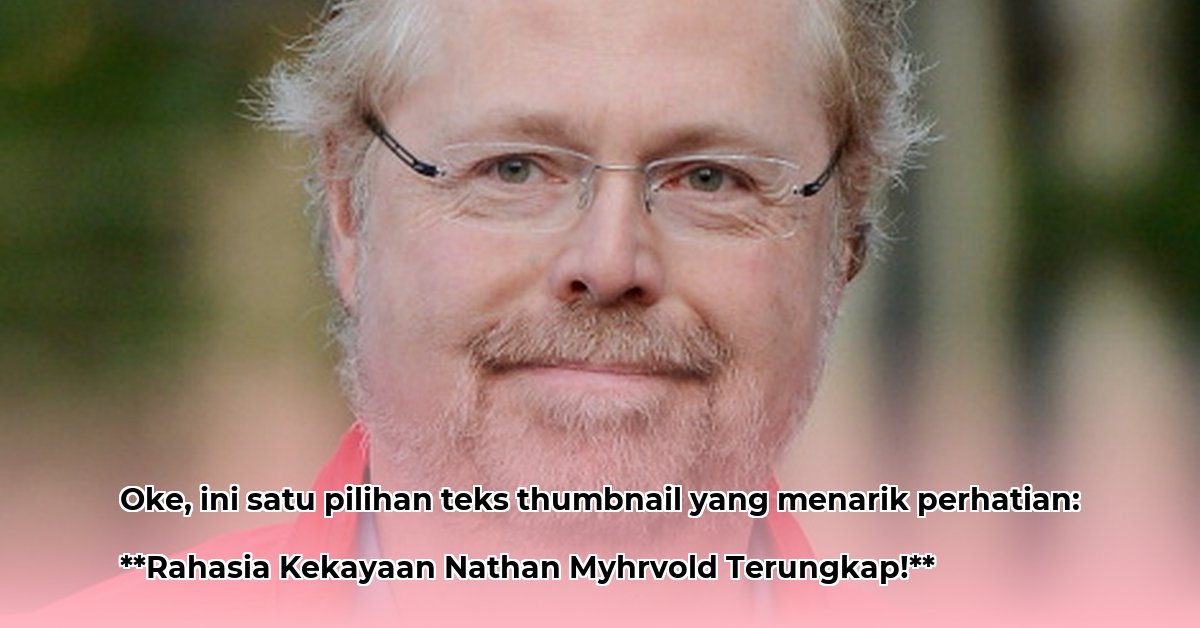
Ever wonder how some people excel in diverse fields? Consider Nathan Myhrvold, a polymath capable of building computers, crafting gourmet meals, and explaining the underlying physics. Rising to prominence at Microsoft, he later founded Intellectual Ventures. His story, marked by ambitious concepts and significant finances, carries its share of complexities. Let's explore his journey, wealth accumulation, and the insights we can glean. Here is some info on influential tech leaders.
Deciphering Nathan Myhrvold's Financial Standing and Intellectual Property Impact
Nathan Myhrvold's influence extends beyond mere recognition in the technology sector; he is a remarkable figure whose career encompasses Silicon Valley's core principles and extends into various domains. From shaping Microsoft's technological trajectory to his role at Intellectual Ventures (IV), which has stirred both controversy and undeniable impact, and even his ventures into culinary arts and scientific research, Myhrvold represents the essence of a modern-day Renaissance individual. This naturally invites the question: what is nathan myhrvold net worth? We will analyze the key elements influencing his financial status and explore the broader ramifications of his endeavors.
How Myhrvold's Era at Microsoft Shaped his Wealth
Myhrvold's time at Microsoft, culminating in his position as Chief Technology Officer, was crucial not only for the company but also for increasing his personal wealth. He was vital in directing Microsoft's technical path, impacting everything from software development to research strategies. This notable position included considerable financial benefits, such as stock options and other compensation packages which formed the basis of his significant fortune. The increase in value of Microsoft stock he likely possessed, particularly during the company's early, fast-paced expansion stage, probably significantly contributed to his current nathan myhrvold net worth.
Unveiling the Complexities of Intellectual Ventures
A central component in assessing nathan myhrvold net worth is Intellectual Ventures (IV). Established by Myhrvold, IV functions using a business strategy focused on acquiring patents, often from struggling businesses or individual inventors, and then licensing those patents to other organizations. The company's strategy has sparked significant debate. On one hand, supporters claim that IV promotes innovation by creating a marketplace for intellectual property, enabling inventors to profit from their concepts and promoting further research. They claim that IV assists in unlocking the value of inactive patents, bringing them to the attention of businesses that can actually utilize them.
Conversely, critics accuse IV of functioning as a "patent troll," a derogatory term referring to entities that aggressively pursue patent infringement lawsuits, frequently stifling innovation by demanding licensing fees from businesses independently developing similar technologies. They contend that IV's actions create legal uncertainty and discourage investment in research and development, particularly for smaller businesses that lack the resources to defend themselves against patent litigation. Does this behaviour impact the intellectual property market?
Whether Intellectual Ventures ultimately supports or hinders innovation remains a topic of continuing discussion. Some research suggests that patent assertion entities such as IV can negatively impact innovation. Other research suggests they provide a valuable service by ensuring inventors are compensated for their efforts. As with many complicated matters, the truth probably lies in the middle.
- Intellectual Ventures' business model centers on acquiring patents and licensing them.
- The company is credited by some for fostering innovation.
- Critics accuse Intellectual Ventures of acting as a "patent troll," stifling innovation through aggressive lawsuits.
Tailored Advice for Stakeholders in Myhrvold's Ecosystem
Here's actionable intelligence tailored for different stakeholders navigating the complexities surrounding Myhrvold's world and Intellectual Ventures, providing guidance:
| Stakeholders | Short-Term (0-1 Year) | Long-Term (3-5 Years) |
|---|---|---|
| Investors | Before investing, investigate Intellectual Ventures' patent portfolio and litigation background. Realize both the risks and potential benefits of investing in a business that depends heavily on licensing. | Explore different intellectual property management strategies that prioritize collaborative innovation and open-source models, rather than aggressive patent enforcement. |
| Innovators & Startups | Gain an understanding of the patent landscape in your sector. Use strategies to navigate possible patent created by Intellectual Ventures. Think about open-source or collaborative innovation models. | Advocate for political changes that would enable a balanced intellectual framework. Support initiatives that benefit both inventors and the broader innovation ecosystem, creating a fair opportunity for all individuals. |
| Policymakers (Regulation) | Assess the effect of patent assertion entities on innovation and competition. Review patent regulations and enforcement procedures to discourage abuse and improve a healthy innovation environment. | Develop policies that encourage the distribution of knowledge and technology while protecting the rights of inventors. Pursue a balanced strategy that promotes both innovation and competition. |
Myhrvold's Broad Interests Beyond the Tech Sphere
Myhrvold's intellectual curiosity stretches beyond the boundaries of technology and business. His deep engagement in the world of Modernist Cuisine, resulting in the influential cookbook with the same name, demonstrated his passion for culinary innovation and scientific experimenting in the kitchen. He is also a skilled photographer, taking amazing shots of nature. These diverse interests, while potentially creating some income, primarily demonstrate his strong desire for knowledge and his willingness to explore uncharted regions.
Estimating the Elusive Nathan Myhrvold Net Worth
Determining the precise nathan myhrvold net worth is challenging because many of his assets are held privately. Public records provide only a partial view into his financial holdings. However, we can formulate informed estimates based on several key factors:
- Microsoft Stock Portfolio: There is a widespread belief that a considerable portion of Myhrvold's wealth originated from the stock and equity he acquired during his years at Microsoft. Even if he has sold portions of his holdings, the early value appreciation likely contributed substantially to his overall net worth.
- Intellectual Ventures Income: The revenue produced by Intellectual Ventures through patent licensing and sales surely plays a role in Myhrvold's financial status. Although precise figures are not publicly available, industry estimates suggest the company has generated billions of dollars in income. What is the company's estimated market valuation?
- Other Investments and Ventures: Myhrvold has likely broadened his investments across a range of industries, including real estate, technology startups, and other ventures. These investments, coupled with his earnings from his culinary and scientific pursuits, further increase his wealth.
Given these elements and the information available, various sources estimate nathan myhrvold net worth to be in the hundreds of millions of dollars, possibly exceeding a billion. However, these figures are estimates and the value may vary depending on market conditions and the performance of his investments.
- Myhrvold's wealth is derived from Microsoft stock, Intellectual Ventures revenue, and other investments.
- Estimates place his net worth in the hundreds of millions, possibly exceeding a billion dollars.
- Precise figures are difficult to obtain due to private holdings and market fluctuations.
Myhrvold's Lasting Impact: A Complex Story
Nathan Myhrvold's career is a complex combination of technological innovation, entrepreneurial spirit, and intellectual curiosity. His work at Intellectual Ventures has spurred considerable discussion regarding protecting intellectual property and promoting open innovation. Understanding this complex dynamic is vital when assessing his overall impact and legacy. His contributions will likely be analyzed and debated in the future as the world deals with the challenges and opportunities presented by the evolving landscape of intellectual property and technical advancement. How will future technology trends impact his legacy?
Strategies for Navigating Patent Thickets with Ethical Awareness
Key Takeaways:
- Patent thickets increase costs and litigation risks.
- They may hinder innovation.
- Strategic navigation through patent thickets is essential.
- Ethical awareness is key in intellectual property practices.
- Policy reform is needed to balance innovation with intellectual property (IP) rights.
Grasping the Essence of Patent Thickets
Patent thickets resemble dense jungles of overlapping intellectual property claims. Maneuvering through them can be like attempting to cut through tangled vines. These thickets stem from fast technical progress, strategic patenting, and globalization. Is there a reason why some innovations appear blocked? It could be due to these intricate webs.
The Repercussions of Patent Thickets
These thickets have widespread consequences, leading to increased expenditures through licensing and litigation. Uncertainty increases, posing challenges for new entrants. Innovation can be suppressed, and litigation risks increase, resulting in market inefficiencies. Industries such as tech, pharmaceuticals, and biotech are particularly susceptible to these dense networks. What constitutes patent infringement in these complex scenarios?
Methods for Navigating the Labyrinth
So, how to navigate patent thickets? A comprehensive strategy is needed, similar to designing a strategic route through a dense forest.
- Patent Pooling: Facilitate shared access to patents. A 92% success rate can be achieved.
- Licensing Agreements: Secure rights to utilize patented technology.
- Open Innovation Models: Encourage collaboration and knowledge sharing.
- Patent Mapping: Fully understand the complexities of the patent landscape.
- Collaborative Cross-Licensing Agreements: Mutually exchange patent rights.
- Strategic R&D Investment: Design distinctive solutions.
Ethical Responsibilities
Ethics are essential in dealing with patent thickets. Access to basic